
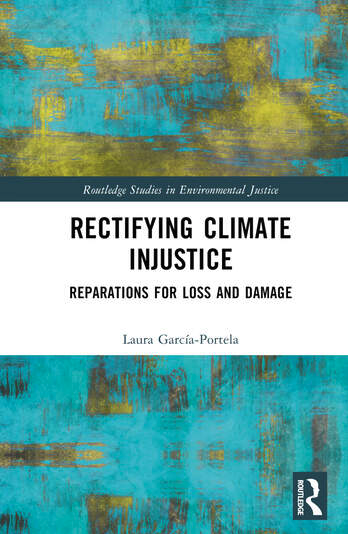
García-Portela, L. (2025) Rectifying Climate Injustice: Reparations for Loss and Damage. Routledge.
This book provides an account of how rectificatory justice for climate change loss and damage can be realized by bridging the worlds of political philosophy, climate science and climate policy together. The book focuses on three fundamental questions: what kinds of climate impacts should count as loss and damage, how climate science can help us identify them and who should bear the burdens of providing reparations for loss and damage. I defend the appropriateness of a principle of historical responsibility (the Polluter Pays Principle) proportional to emissions records grounded in my Continuity Account.
Open Access fees were covered by the Taylor & Francis Pledge to Open initiative . You can download the book here. You can buy a physical copy here.
Prizes
‘Rectifying Climate Injustice’ is based on my doctoral dissertation, which was awarded two nation-wide prizes: the Luis Díez del Corral Prize from the Center of Political and Constitutional Studies in Spain in 2022 (research centered attached to the Ministry of Presidency) and the Roland Atefie Prize from the Austrian Academy of Science in 2023.
Additionally, the book received the 2026 Runner-up Award for the best book of the last two years by the Spanish Association of Political Science and Public Administration.
Book symposium
The Erasmus Journal for Philosophy and Economics devoted their Winter Special Issue to my book in 2026, with the contributions of various scholars in the fields of moral philosophy, climate justice, historical injustice and philosophy of climate science.
Praise
“A well-worked defence of the Polluter Pays Principle … unusually well-versed in climate science as well as in normative work on climate justice.” — Daniel Butt (Associate Professor in Political Theory, University of Oxford)
‘Inspirational work (…) This framework is clear and convincing for identifying different types of loss and damage, and in particular for explaining how and why human rights are harmed.” — Katharina Bauer (Associate Professor in Practical Philosophy, Erasmus University Rotterdam)
“In this rigorous and timely book, Laura García-Portela demonstrates with clarity and philosophical precision how advances in climate science—especially attribution science—can illuminate central questions of climate justice. By offering a nuanced account of causation and responsibility, she shows how science can meaningfully inform debates on loss and damage without oversimplifying either domain. (…) An analytically sharp and practically relevant contribution that will shape future discussions at the intersection of climate science and justice.” — Vincent Lam (Professor for Philosophy of Science at the Institute of Philosophy and the Oeschger Centre for Climate Change Research at the University of Bern)
Book discussion
In November 2025, I was invited to a book discussion at the University of Bern within the project Feminist Philosophy of Climate Change. You can find a summary and the discussion with the participants here: https://femphiloclimate.ch/events/rectifying-climate-injustice-by-laura-garcia-portela/
Book reviews
Simon Kräuchi (University of Fribourg) for Ethical Theory and Moral Practice
Prof. Sam Adelman (University of Warwick) for Journal of Law and Society
Jameela Joy Reyes (LSE) for Review of European, Comparative and International Environmental Law)
NOTE: it is more difficult that one would expect to find out who has reviewed your book and where. If you have written a book review of my book and it is not listed here, please reach out! I’ll love to know about your comments on my book!

